Ten Things: an archaeology of design · the eleventh thing · draft of 26 November 2026

When does a thing stop being what it was made to be?

An atlas of one handset: the original iPhone I bought on eBay in the winter of my freshman year and used as my daily driver.

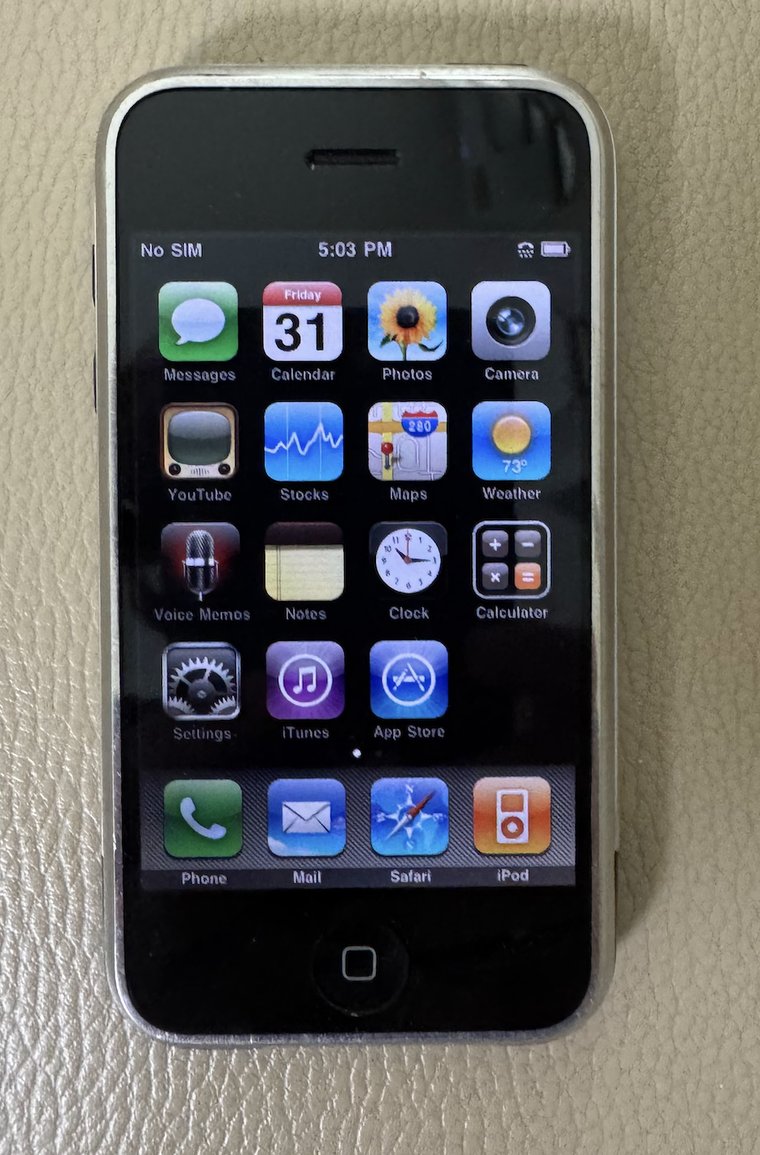
My original iPhone lying on a pale leather surface, switched on. The status bar reads No SIM and 5:03 PM. Fifteen app icons fill the screen, and the dock holds Phone, Mail, Safari and iPod.
My handset. The status bar reads No SIM.
Follow
3 Aug 2026
a Wi-Fi device

T-Mobile retires 2G, the last major US carrier to do so. No US cellular network will take an original iPhone.

US networks it can join
None
9 Jan 2007, on stage3 Aug 2026, off the air

The first track is the model's documented life. The second is my own recollection of what the handset became after I bought it.

The date I bought it is still to add.

It was one of my first purchases on eBay. I loved its music player, its simplicity and its compact size, and visiting the BBC website on it became a daily routine. What surprised me was other people. On my first day with it a friend thought I was rich. Within a week people were asking what it was, and I made friends through their questions.

An object sold as technological progress was connecting people through its obsolescence. The word obsolete describes none of that. So this is an atlas of eight plates. Each starts from a photograph, an interaction or an encounter with my handset and follows its connections outward.

How to read the plates

Solid line: documented for this model Dashed line: uncertain or conjectural Violet dashes: my own evidence, still to add
Evidence
Show the plates that apply a tactic
Eight plates, sixteen of the syllabus's eighteen tactics.
1PLATE 1 OF 8

A phone that cannot phone

Beware the concept of function; it only applies locallyIs this even the thing that needs understanding? Is it even an object?
Starts froman interaction, my own daily use

The name on my object says phone, and the name is no longer true. The original iPhone speaks only 2G. AT&T, the carrier it was sold locked to, shut down its 2G network on 1 January 2017 (MacRumors, 2017).

T-Mobile retired its own on 3 August 2026, the last of the three major US carriers to do so. The original iPhone can now join no US cellular network (MacRumors, 2026).

What my handset's own screen says
Enlarged detail of the status bar on my handset: No SIM on the left, 5:03 PM in the centre, a battery symbol on the right.
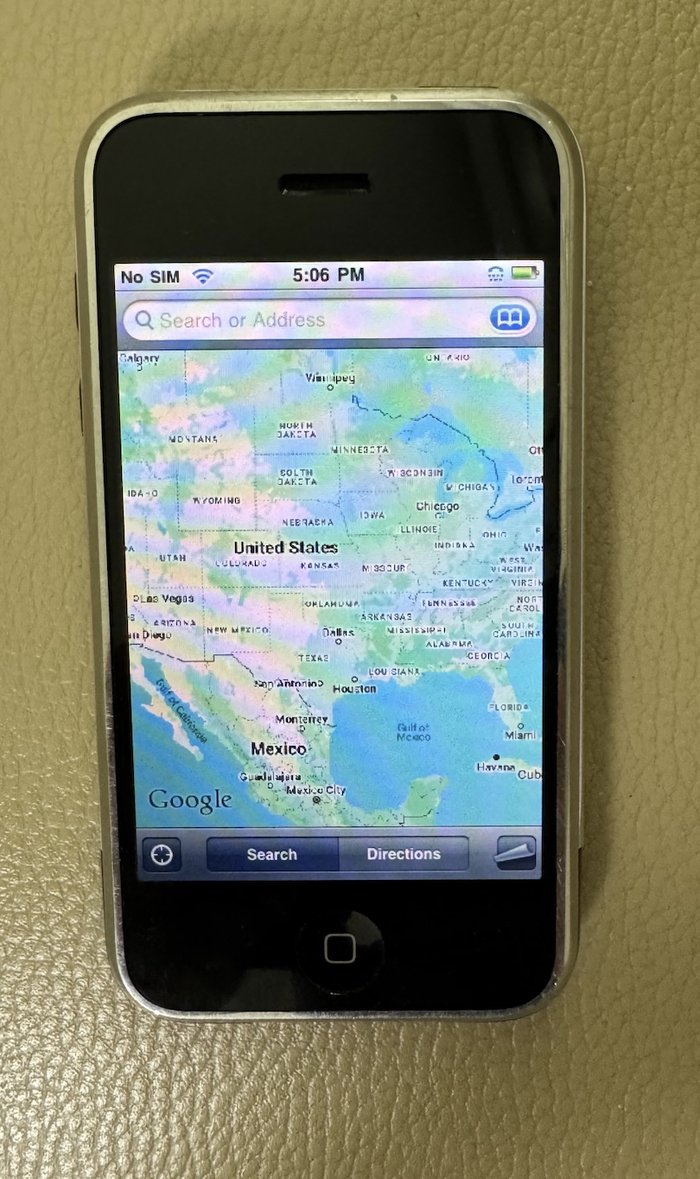
The same handset showing the Maps app: a map of the United States and Mexico with Google's name in the corner. The status bar reads No SIM, with a Wi-Fi symbol.

The status bar, enlarged from my photograph of the home screen. Where a carrier's name would be, it reads No SIM.

A second photograph, three minutes later. Still No SIM, now with a Wi-Fi signal, and Maps draws the United States with Google's name in the corner.

The phone part is silent. The parts that never needed a carrier still answer.

The castle taught me that function is an agreement between a thing and a place. Phone was true of this handset only while towers, spectrum and a contract held it up. Nothing in the aluminium changed this August. A network somewhere else did.

My own use had already shown this. The handset was an AT&T one, and its phone service did not work while I used it daily. I carried a second phone as well. My attachment did not centre on calling. It centred on music, browsing and social encounters, and later on photographs and the news.

The castle's question, put to the handset

It requests

  • A bare fingertip
  • Eyes on the glass
  • In 2007, a carrier contract

It allowed me

  • Music
  • A browser, and the BBC each day
  • Photographs
  • A reason for people to talk to me

It refuses

  • A screen reader
  • A standard headphone plug without an adapter
  • A battery swap by its owner
  • Since August 2026, any US cellular network

The flat glass I experience as simplicity shut blind users out for about two years, until the iPhone 3GS brought VoiceOver in June 2009 (Braille Monitor, 2009). My enjoyment depends on being the kind of user it anticipated.

If what made it a phone was never inside the case, the object in my hand is only part of the thing.
DocumentedBoth shutdown dates. No screen reader on this model. In my photographs, my handset reads No SIM and shows a Wi-Fi signal.
My recollectionIt was an AT&T handset, and the phone service did not work while I used it daily. Two things failed: the YouTube app, and opening some websites.
UncertainWhy those two failed: the handset, the network or the services themselves.
Still to add
2PLATE 2 OF 8

Opened on launch day

Open the black box: what is connected?
Starts froma photograph, a published teardown

The inside of my phone was public before most people had touched the outside. iFixit bought two 8 GB iPhones and took one apart on 29 June 2007, the day it went on sale (iFixit teardown). I use published teardowns because I will not open my own handset.

Choose a number on the photograph, or a note beside it
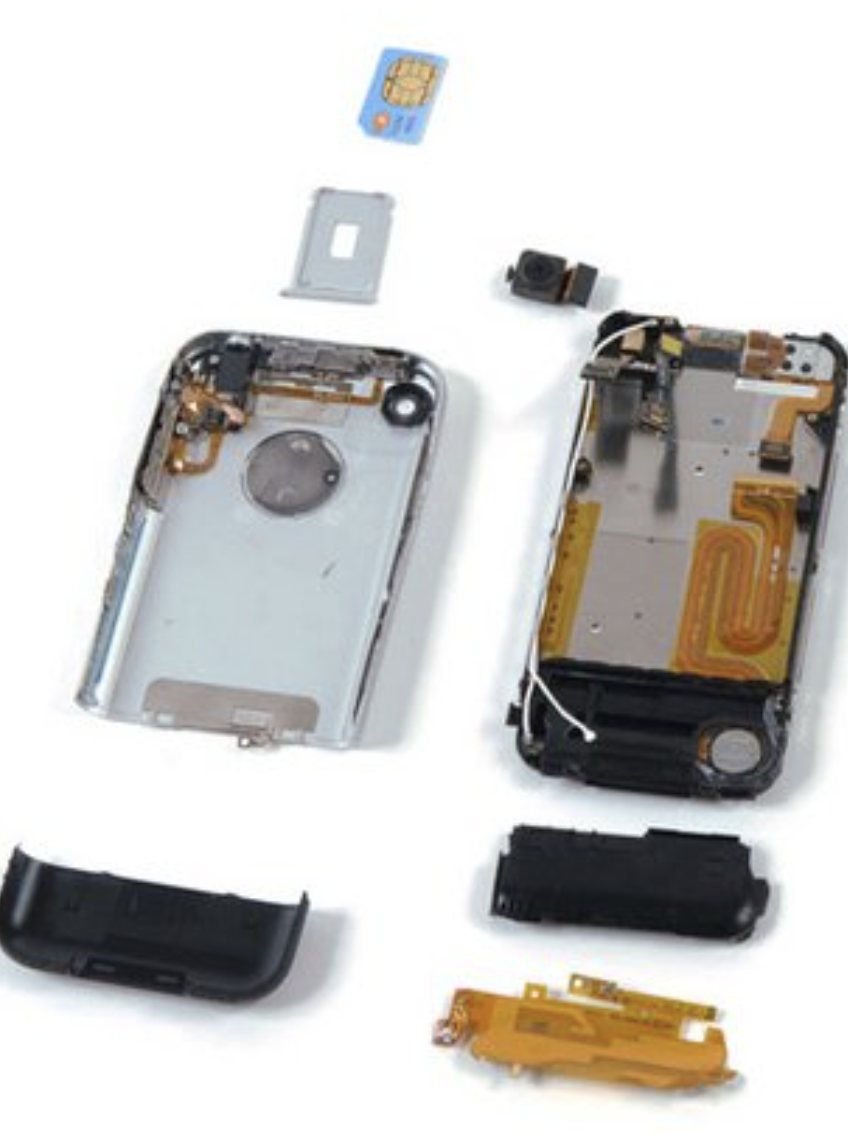
An original iPhone taken apart on a white surface: SIM card and tray at the top, a camera module, the aluminium back on the left, the main assembly on the right, two black plastic pieces and a flex cable below.
about 5 cm, estimated from the 4.5 inch case
The teardown photograph this plate starts from. Its source and credit are still to confirm.

Opening the box changes the answer to who made it. The analyst firm iSuppli traced the parts within days (Computerworld, 2007). Samsung supplied the processor and memory, about 30 percent of the cost. Infineon supplied the radio chips and the German firm Balda the touch-screen module.

iSuppli put parts and manufacturing at $263.83 for a phone sold at $599.

The box does not open all the way. Another lab found that the main processor carried Apple's markings over a Samsung chip, and that its flash memory was the same part used in an iPod nano (AppleInsider).

DocumentedThe part makers named here, for this model, from 2007 teardowns.
UncertainWhich display maker's panel is in my handset. Who made its battery cell: the teardown could read only Apple's part number, 616-0290.
Still to add
3PLATE 3 OF 8

Glass

Be sceptical of claims for new inventionBe alert to the shock of the oldBeware attributing the design of an artifact to a designer at all
Starts froman interaction, my fingertip on the screen

The surface I touch every day was not on the phone Steve Jobs held up. The handset shown in January 2007 had a plastic screen, like an iPod (Tom's Guide, 2019). Jeff Williams of Apple has told how Jobs called him the next day because the prototype had scratched in his pocket, and wanted glass by the June launch.

In Williams's account the answer was an experimental glass sitting on a shelf in a Corning research lab.

What is old in the new
GlassAn experimental glass already on a supplier's shelf.
MemoryThe same flash part as an iPod nano.
Radio2G EDGE, with no 3G (iMore).
ChipsMostly "tried-and-true components" (MIT Technology Review, 2007).
NewThe multitouch screen, and the way the old parts were joined.

So what was new? The parts were mostly old. The connection was new: shelf glass, standard chips, an iPod and a phone contract, joined behind one surface and one story.

It also makes me wary of naming a designer. The glass in my palm exists because of a scratched prototype, a supplier's shelf and a six-month scramble.

DocumentedPlastic at the keynote and glass at launch, on Williams's account as reported in 2019.
My recollectionI carried a second phone as well, so this handset added to my phone and did not replace it.
UncertainA second version, credited to Walter Isaacson, has Jobs going to Corning's chief executive himself. Corning's own account differs again (PhoneArena, 2013).
Still to add
4PLATE 4 OF 8

The soldered battery

What remains? Follow the thing past its use: who maintains itWhere does the thing end; which services complete it?
Starts froman interaction, plugging my handset in to charge

The battery is where my handset is most mortal, and its care was designed to be someone else's job. iFixit found the cell soldered to the logic board. An owner could not swap it.

Apple's answer was a service. Out of warranty, the owner paid $85.95, posted the phone to Apple and waited about three business days. The repair erased everything on it (Computerworld, 2007).

Apple said the cell would take 300 to 400 charges. A consumer group worked out that someone charging nightly might need a replacement within ten months.

Arithmetic on Apple's 2007 figure, not a measurement of my battery
About 10 to 13 months
Before 300 to 400 charges are used up

My handset has not followed that arithmetic. Its battery still lasts a long time between charges, though I do not know whether the cell is the original.

In 2007 the answer to who maintains it was Apple, by post, for a fee, at the cost of your data. So the thing never ended at its case. A repair desk completed it, as a network did in Plate 1.

Nineteen years on that desk is closed to my phone: Apple offers no service for this model. What exists is iFixit's own battery replacement guide. Maintenance has passed from the maker to owners with soldering irons. The Bentley case made the same point about a ninety-three-year-old car.

DocumentedThe soldered cell. The 2007 mail-in programme, its price and its terms.
My recollectionThe battery lasts a long time between charges. Apple offers no service for this model today.
UncertainWhether the cell in my handset is the original.
Still to add
5PLATE 5 OF 8

Aluminium, black plastic and one line of small print

Follow the energy and the elements: from whose ground, through whose hands?Making-with: who was made invisible?
Starts froma photograph, the back of my handset

The back of the phone names two places and no people. A museum record of the same model transcribes the inscription: "Designed by Apple in California Assembled in China" (The Henry Ford).

The label gives design a company and a state. It gives assembly a country. It gives mining, smelting, moulding and soldering nothing at all.

Show

    The casing tells one material story plainly. The body is bead-blasted aluminium, and the lower back is a black plastic band so that radio signals can pass (iMore). The band is the one place where the case admits that it depends on something outside itself. On my handset the aluminium has worn and the band still looks fine.

    Here my method reaches its limit. General accounts of where phone metals come from are easy to find. I have found none that traces this model's casing or battery cell to a mine or a smelter.

    I will not borrow a general story and attach it to my handset. The gap is itself a finding for the thread on labour. The hands are missing from the record as well as from the object.

    DocumentedThe inscription. Foxconn as assembler (Wikipedia; PhoneArena). The plastic band as an opening for radio.
    My observationThe aluminium has worn. The black plastic looks fine.
    UncertainEvery source of raw material. The factory and date behind my own serial number.
    Still to add
    6PLATE 6 OF 8

    The keynote

    Consider the processes and performances, the scenographies and dramaturgiesWhat is being connected? It is often storiesWhat future was it recruited to promise, and what does the promise hide?
    Starts fromthe recording of the keynote of 9 January 2007

    The iPhone was a performance before it was a product. Jobs presented it at Macworld in San Francisco on 9 January 2007 (ABC News, 2007). Nobody could buy one until 29 June.

    The story connected three known things. In ABC's report he named them as "An iPod, a phone, an Internet communicator", then revealed a single device.

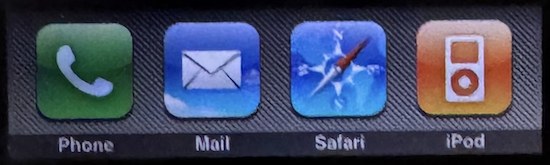
    Detail of the dock on my handset: four icons labelled Phone, Mail, Safari and iPod.
    The dock of my handset, from my own photograph. The keynote's three things still sit side by side: a phone, the internet as Mail and Safari, and an iPod.

    The staging hid an unfinished thing. Andy Grignon, the engineer in charge of its radios, later said the prototype could not play a whole song or video without crashing (MacRumors, 2013, summarising Fred Vogelstein in the New York Times). Engineers found one order of tasks that made it appear to work and called it the "golden path".

    Try the demo in either order
    five bars, whatever the reception
    The prototype is on stage. Nothing has been pressed yet.

    Sending an email and then surfing the web worked. The reverse tended to crash the prototype. AT&T brought in a portable cell tower for the call (9to5Mac, 2017).

    What did the promise hide? The bugs, the plastic screen of Plate 3, and a price of $499 or $599 on contract. The future on that stage was for people who could pay for it.

    That price still clings to the object. On my first day with it, a friend thought I was rich because the phone seemed expensive.

    This is where the lord's two bodies helps me. The castle's lord had a mortal body and an office that outlived him.

    Two bodies
    The office: the iPhoneThe body: my handset
    BeginsOn a stage, 9 January 2007Again, on eBay, in the winter of my freshman year
    AgesRe-embodied in each new handsetOne cell, soldered in, fading
    NetworkMoves to each new standard2G only, now switched off
    SoftwareStill updatedStopped at iPhone OS 3.1.3, February 2010

    The keynote says the iPhone begins there. My handset says one iPhone can begin again, as something the keynote never scripted.

    DocumentedDate, venue and prices. The staged demo, on one named engineer's testimony.
    My recollectionI found the keynote very interesting.
    UncertainI have read summaries of the Times article, not the article itself. Grignon's is one account.
    Still to add
    7PLATE 7 OF 8

    Itinerary

    Take the point of view of the artifact; trace its itinerary, as well as its biography
    Starts froman encounter, the eBay listing where I first saw my handset

    From the handset's point of view I am a late chapter, and most of its life is missing from my record. A biography of the model would stop in 2008 or 2010. Its itinerary keeps going.

    DateWhat happenedWhat a handset like mine could be
    3 Aug 2026T-Mobile retires 2G, the last major US carrier to do soA Wi-Fi device
    16 Jul 2023A factory-sealed 4 GB example sells for $190,372.80An auction lot, if never opened
    1 Jan 2017AT&T shuts down 2GDead on its original carrier
    Feb 2010Last software update, iPhone OS 3.1.3Frozen
    Jul 2008Apple discontinues the model as the iPhone 3G arrivesSuperseded
    11 Jul 2008iPhone OS 2 brings the App StoreAble to run other people's software
    5 Sep 2007The 8 GB model drops from $599 to $399Cheaper, ten weeks after launch
    29 Jun 2007Goes on sale in the United StatesA phone
    Spring 2007Photographed on a Foxconn assembly lineParts becoming a product
    9 Jan 2007Announced on stageA prototype on a golden path

    Rows from MacRumors, 2026; MacRumors, 2023; MacRumors, 2017; Wikipedia; PhoneArena.

    The auction row unsettles my own story. A sealed example fetched more than 300 times its launch price because nobody ever used it. Mine matters to me for the opposite reason. Collecting and using pull the same object toward different futures.

    The Henry Ford museum already holds this model as object 2008.146.1, listed as not on exhibit. My handset is the same model outside the archive, still in use.

    My photographs add a line to my own handset's biography. Its home screen carries the App Store and Voice Memos. Voice Memos arrived with iPhone OS 3 on 17 June 2009 (Wikipedia), so someone was still updating this handset more than two years after the keynote.

    DocumentedEvery dated row, for the model. From my photographs: my handset runs iPhone OS 3.
    UncertainEverything about my own handset between its first sale and my purchase: owners, places, years in a drawer.
    Still to add
    8PLATE 8 OF 8

    The encounter

    Seek understanding through empathyConsider the particulars of experienceSense, think, feel, evaluate
    Starts froman encounter, a peer noticing the phone in my hand

    The most surprising thing my handset did was social, and I cannot yet explain it from my side alone. My peers were intrigued, and the phone became a way to start conversations and make friends.

    My own record, from recollection
    First dayVery cool. A friend thought I was rich, because the phone seemed expensive.
    After a weekPeople asked what it was, because it was so unusual. I made friends through those questions.
    LaterI used it to take pictures and to search the news, and it worked.
    VerbWho, whenWhat the record shows
    FeelMe, first dayIt was very cool
    EvaluateA friend, first dayExpensive, so its owner must be rich
    ThinkPeople, first weekWhat is this?
    EvaluateMe, laterA camera and a news reader that still work
    SenseThree people I askedCool

    Two readings appear in that record. On the first day the phone read as money. The price it launched at in 2007 seems to cling to it, as Plate 6 suggests. After a week it read as rare, and rarity invited questions.

    The tactic of empathy treats this record as one standpoint among several. It is mine, and it is memory. So I asked three other people what they sensed, thought, felt and judged.

    All three gave the same short answers. It looked cool, they thought it was a phone, it felt cool, and they judged it nice.

    Set beside my own record, they hold a contradiction. I remember people asking what it was. These three say they thought it was a phone. Both may be true if they knew it was a phone and wanted to know which one. I still need to ask.

    They also turn Plate 1 around. The networks say this handset can no longer be a phone. Three people who met it say it is one. Its function has ended on the air and persists in the hand.

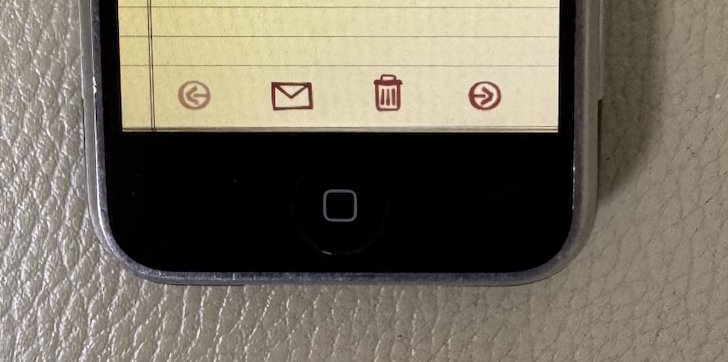
    Close view of the bottom of my handset: yellow lined paper and hand-drawn style icons in the Notes app, the single round button, and a scuffed bright metal edge.
    Particulars from my own photograph: yellow lined paper in Notes, one button, and a bright metal edge scuffed dull.

    The tactic of particulars asks what exactly people noticed. My record names two things: the look of expense, and strangeness. In my own use the particulars were the music player, the compact size, the camera and a daily visit to the BBC website.

    DocumentedMy own recollection of three stages. Three short accounts from other people, identical in all four answers.
    UncertainWhy the accounts are so alike, and what a longer conversation would add.
    Still to add

    What changed

    I began by asking when a thing stops being what it was made to be. The plates suggest the question was badly formed. My iPhone was never one thing, and "made to be" was itself a staged claim.

    Function turned out to live in networks I do not own. The object turned out to be a gathering of firms, materials and services, most of them absent from its label. Its beginning was a performance, and its life has run on long after its official end.

    So obsolescence did not happen inside my handset. Other parties ended a set of relations: a carrier, a software team, a repair desk. Where those ended, new ones began, with a seller on eBay, with me and with my peers.

    My own record gives the plainest answer to the opening question. In my hands the handset never worked as a phone. It became, in order, a sign of money, a question people asked, and a camera and news reader that worked.

    The three people I asked complicate this. To them it is still a phone.

    One more tactic belongs here, the warning to watch out for total social facts. The phone now touches labour, law, attention, friendship and mining at once. My handset is a small, early window onto that, and I have tried not to let it stand for the whole.

    Still open:

    Collaborators and sources

    For this project, I used written accounts online, my notebook and the sources below. Three people answered my four questions for Plate 8.

    First-hand evidence so far is my recollection in Plates 1, 3, 4, 5, 6 and 8, three short accounts in Plate 8 and three photographs of my handset. Nothing here reports a measurement of my own yet. Tactic wording is from the Fall 2026 syllabus. Web sources were opened on 25 and 26 November 2026.

    1. iFixit, iPhone 1st Generation Teardown, 29 June 2007
    2. iFixit, battery replacement guide
    3. Computerworld, iSuppli teardown, July 2007
    4. Computerworld, battery complaint, 2007
    5. AppleInsider, Semiconductor Insights teardown, July 2007
    6. MIT Technology Review, Apple's iPhone, 15 August 2007
    7. ABC News, keynote report, 9 January 2007
    8. MacRumors on Vogelstein's account, 4 October 2013
    9. 9to5Mac, keynote inside story, 9 January 2017
    10. Tom's Guide, plastic to glass, 12 July 2019
    11. PhoneArena, Isaacson's version, 9 February 2013
    12. PhoneArena, assembly photographs
    13. iMore, history of the original iPhone
    14. Wikipedia, iPhone (1st generation)
    15. Wikipedia, iPhone OS 3
    16. The Henry Ford, object 2008.146.1
    17. Braille Monitor, National Federation of the Blind, November 2009
    18. MacRumors, AT&T ends 2G, 17 January 2017
    19. MacRumors, T-Mobile ends 2G, 6 August 2026
    20. MacRumors, record auction, 17 July 2023